
How many times have you clicked “Confirm” in a wallet and trusted the transaction without a second thought? For DeFi power users—traders, liquidity providers, and on‑chain strategists operating across multiple EVM chains—that casual click is the operational center of risk. This article dissects the mechanics that matter when you choose a multi‑chain wallet today: how transaction simulation, pre‑transaction risk scanning, and hardware integrations change the decision calculus, where those protections stop, and what trade‑offs remain for U.S. users balancing convenience, regulatory realities, and operational security.
We’ll use a concrete, modern example to ground the discussion. The wallet in focus implements a set of practical defenses that have become central to how serious DeFi participants manage signing risk: pre‑signature simulation of the exact token balance changes and fee impact, automated network switching, approval revocation, and broad hardware wallet support. Those features shift the threat model from “blind signing” to “informed signing,” but they do not eliminate systemic vulnerabilities. Read on for a mechanism-first explanation, explicit limitations, and a compact decision framework you can reuse when comparing multi‑chain wallets.
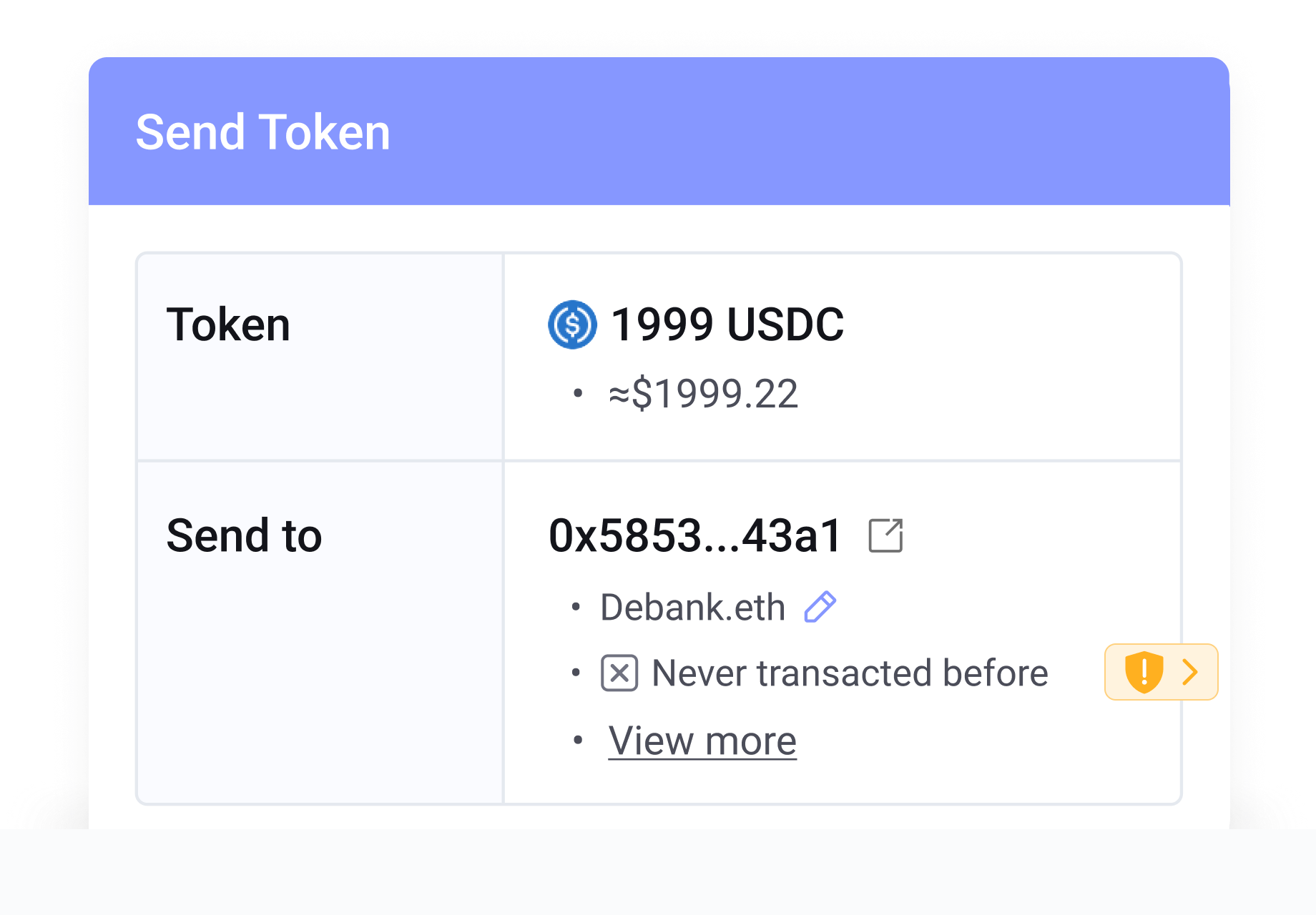
How transaction simulation and risk scanning actually work
At its core, transaction simulation runs a dry‑run of the signed transaction against a node or local EVM interpreter before the wallet emits a real signature. Mechanically, the wallet constructs the transaction, sends it to a simulation engine (either a light client, a remote node, or an internal interpreter), and reads the post‑state: token balances, contract state changes, and gas estimate. The user then sees the exact estimated token balance deltas and expected fee cost rather than a terse calldata string.
That clarity transforms two common failure modes. First, it prevents users from being tricked by opaque calldata that could drain tokens. Second, by surfacing precise fee impacts, it avoids surprises on high‑latency, high‑fee chains. A complementary layer—pre‑transaction risk scanning—compares the target contract and call pattern against known risk signals: addresses previously associated with hacks, suspicious approval requests (such as unlimited approvals), or non-existent recipient addresses. If a match or heuristic threshold is reached, the wallet alerts the user or halts the flow.
These are practical, verifiable defenses. They do not rely on promises but on observable state: you can test that a simulated swap would remove X tokens from your balance and cost Y in gas. For power users who execute complex strategies—batch swaps, multi‑hop routes, or approvals across many chains—this per‑transaction transparency substantially reduces accidental exposure.
What these features change — and what they don’t
A wallet that simulates transactions and scans for known risks materially shifts the residual risk profile, but it is not a panacea. Here are the critical boundaries:
- Known‑risk detection is short of omniscience. Blacklists and heuristics catch many patterns, but novel exploit logic, time‑delayed drain mechanisms, or deliberately obfuscated calldata can evade rules. Simulation reveals the near‑term state change, but if the exploit depends on off‑chain oracle manipulation or a later transaction, the simulation of one call may not expose future loss.
- Open‑source code helps, but audits are not guarantees. An MIT‑licensed, auditable codebase invites inspection and reduces certain classes of supply‑chain risk. Still, the quality of audits and how quickly fixes are deployed after a finding are the operational variables that matter.
- Hardware wallet support reduces private key exposure but increases operational complexity. Extensive integrations with Ledger, Trezor, Keystone and others let you keep keys offline while using the simulation interface. The trade‑off is workflow friction: signing many transactions across 90+ chains becomes slower, and each device has its own UX pitfalls that can cause user error.
In short: informed signing reduces human error and many common scam vectors, but it cannot eliminate systemic protocol risk, oracle attacks, or governance exploits. That difference—less human risk, not zero protocol risk—is crucial when sizing position allocations or deciding whether to use multi‑sig for significant balances.
Design trade‑offs: automation versus control
Two design choices illustrate the practical trade‑offs for power users. First, automatic network switching removes a common source of user error: attempting a transaction on the wrong chain. For active traders juggling Arbitrum, Optimism, and Polygon, auto‑switching is a productivity gain. However, automation can hide the network context: users may miss that a dApp is interacting with a Layer‑2 testnet clone or a similar named but malicious RPC endpoint. The right compromise is interface transparency: auto‑switch, but show a clear confirmation of which chain you’re signing on and what RPC endpoint is used.
Second, the inclusion of an approval revocation tool simplifies a defensive hygiene task—revoking unlimited approvals that expose tokens. The trade‑off is gas cost and time: revocation transactions themselves cost gas and require signing, and a naive revocation strategy across 90 chains is operationally expensive. For institutions, integrating revocation into routine post‑trade automation or using time‑limited approvals is more cost‑effective.
Comparing alternatives and when Rabby’s pattern matters
In the broader ecosystem, wallets like MetaMask, Trust Wallet, and Coinbase Wallet cover the baseline: key management, network switching, and token displays. What separates the pattern described here is the additional explicit layer: pre‑transaction simulation plus risk scanning plus deep hardware and multi‑sig integrations. For U.S. DeFi power users who move significant value, those features matter most when your operations include:
– Frequent approvals for yield strategies across multiple EVM chains.
– Automated or semi‑automated trading that produces many micro‑transactions per day.
– Institutional or shared custody requiring multi‑sig and enterprise connector support.
The practical consequence is a shift in the cost curve: you accept a little more UX friction (confirmations, hardware prompts) in return for clearer state visibility and fewer “I didn’t realize” losses. If you manage protocol‑level exposure carefully—use multisig for treasury, route large swaps through time‑tested aggregators, and maintain a small hot wallet for active trading—this pattern is likely a net security and productivity win.
A compact decision framework for choosing a multi‑chain DeFi wallet
When comparing wallets, ask four concrete questions and weight them by your operational role (retail, pro trader, institutional):
- Simulation fidelity: Does the wallet show exact token deltas and gas costs before signing? High fidelity is essential for active traders.
- Risk telemetry: Does the wallet flag known malicious contracts and suspicious approval patterns? This matters for those who interact with new or niche dApps.
- Key custody and integrations: Does it integrate with hardware wallets and multi‑sig/enterprise tools you already use? For institutions, integration trumps UI slickness.
- Operational costs: How much extra friction (time, gas, clicks) will your workflows incur? For high‑frequency strategies, small frictions compound quickly.
Answering these yields a simple heuristic: if you sign many high‑value or automated transactions, favor simulation + hardware + multi‑sig support even at the cost of some speed. If you trade rarely or prioritize fiat rails, the calculus shifts toward wallets with faster onboarding or native on‑ramps (which, to be candid, the wallet pattern under discussion currently lacks).
Limitations, open questions, and what to watch next
Two limitations merit explicit attention. First, absence of a fiat on‑ramp and native staking means the wallet is optimized for active DeFi interaction, not end‑user onboarding to crypto. U.S. users who need a straightforward fiat purchase experience will need an external provider. Second, simulation protects against immediate blind‑signing risks but not indirect or delayed exploits that rely on complex cross‑transaction or oracle manipulations.
Watch for three near‑term signals that will change how much weight you give to these wallets: (1) improvements in cross‑chain oracle security—reducing delayed exploit risk; (2) standardization of transaction simulation interfaces across wallet vendors—making simulation portable and auditable; and (3) broader adoption of time‑limited approvals and better UX for revocation—reducing the long‑tail of exposure from legacy approvals. If those elements mature, the residual risk from protocol‑level attacks could decline materially, raising the ceiling for fully automated DeFi operations.
Practical takeaways for U.S. DeFi power users
Here are three actionable heuristics you can adopt immediately:
1) Treat simulation output as the authoritative transaction description. If the simulated token delta or fee looks wrong, stop and reproduce the call in a test environment or with a smaller value.
2) Use hardware wallets for signing high‑value transactions and multi‑sig for treasury management. The marginal UX cost is outweighed by the security benefit at scale.
3) Regularly run approval revocation sweeps on the chains you use most. Prioritize revoking approvals for expired, dormant, or highly privileged allowances.
For readers ready to explore a wallet that bundles these capabilities into a coherent UX, consider examining the wallet’s browser extension and desktop clients as part of your due diligence: the combination of multi‑chain coverage, transaction simulation, risk scanning, hardware integrations, and revocation tools forms a distinct protection pattern that reduces a common class of user errors.
One practical place to start evaluating that pattern is the rabby wallet offering: test its simulation on a small swap, try approval revocation for a single token, and validate hardware signing on a non‑critical chain before moving real capital.
FAQ
Does simulation stop smart‑contract exploits?
No. Simulation reveals the immediate, simulated state change for the transaction you’re about to sign. It catches blind‑signing and many malicious calldata tricks, but it cannot predict later exploits that depend on oracle manipulation, governance votes, or chained transactions you don’t control. Treat simulation as strong user‑level protection, not a protocol‑level shield.
Is automatic network switching safe for high‑frequency traders?
Automatically switching networks reduces accidental chain errors, but it must be accompanied by clear UI context (which chain, which RPC) and a trusted endpoint configuration. For high‑frequency traders, the time saved can be worth it, provided you validate RPC endpoints and maintain separate accounts for different strategies.
How should an institution integrate these wallets?
Institutions should require multi‑sig for custody, test hardware wallet flows on a sandbox, and integrate wallet risk telemetry into their operational playbooks. Use the wallet’s revocation tools and require simulation output as part of pre‑trade sign‑off for large transactions.